
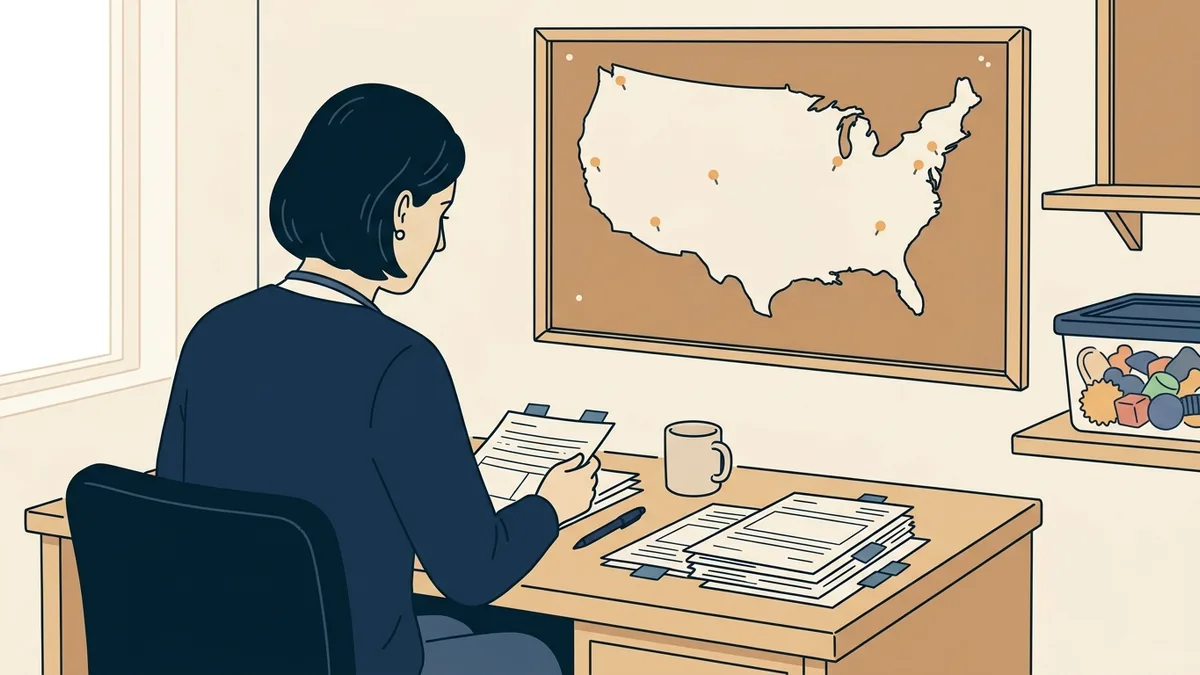
Forty states and the District of Columbia have laws that license or regulate behavior analysts, according to the BACB's licensure table updated September 2026. Colorado enacted its law in 2026 but is not issuing licenses yet. California, Delaware, Florida, Idaho, Maine, New Hampshire, New Mexico, Pennsylvania, South Carolina and West Virginia have no behavior analyst license.
Forty US states and the District of Columbia have laws that license or otherwise regulate behavior analysts. That count comes from the Behavior Analyst Certification Board, which keeps the only maintained national list on its US Licensure of Behavior Analysts page (last updated September 16, 2026) and summarizes the same 40 states in its Regulatory Brief on state licensure laws (version 09/2026). Ten states have no behavior analyst license: California, Delaware, Florida, Idaho, Maine, New Hampshire, New Mexico, Pennsylvania, South Carolina and West Virginia.
One of the 40 needs an asterisk. Colorado's licensure law, HB26-1425, was signed June 2, 2026, but it is not issuing licenses yet; a license will be required from July 1, 2028. The BACB's table links the bill itself rather than a licensing board, which is how the BACB handles states that "may not have implemented an application system." So in practice, 39 states and DC issue behavior analyst licenses today.
Which jurisdictions have a behavior analyst licensure law?
The year below is the year the law was enacted, as the BACB reports it. That is not always the year a board started issuing licenses. Illinois enacted its law in 2022, for example, but the Illinois Department of Financial and Professional Regulation (IDFPR) did not begin licensing behavior analysts until January 15, 2025.
| Jurisdiction | Law enacted | Licensing agency (per the BACB) |
|---|---|---|
| Alabama | 2014 | Alabama Behavior Analyst Advisory Council (Department of Mental Health) |
| Alaska | 2014 | Division of Corporations, Business and Professional Licensing |
| Arizona | 2010 | Board of Psychologist Examiners |
| Arkansas | 2025 | Arkansas Psychology Board ("Registered Behavior Analyst" registration) |
| Colorado | 2026 | Not issuing yet (HB26-1425) |
| Connecticut | 2017 | Department of Public Health |
| District of Columbia | 2024 | DC Board of Psychology |
| Georgia | 2022 | Georgia Behavior Analyst Licensing Board |
| Hawaii | 2015 | Department of Commerce and Consumer Affairs |
| Illinois | 2022 | Department of Financial and Professional Regulation |
| Indiana | 2021 | Professional Licensing Agency |
| Iowa | 2018 | Board of Behavioral Health Professionals |
| Kansas | 2014 | Behavioral Sciences Regulatory Board |
| Kentucky | 2010 | Applied Behavior Analysis Licensing Board |
| Louisiana | 2013 | Louisiana Behavior Analyst Board |
| Maryland | 2014 | Board of Professional Counselors and Therapists |
| Massachusetts | 2013 | Board of Registration of Allied Mental Health and Human Services Professions |
| Michigan | 2016 | Michigan Board of Behavior Analysts |
| Minnesota | 2024 | Minnesota Board of Psychology |
| Mississippi | 2015 | Mississippi Autism Board |
| Missouri | 2010 | Behavior Analyst Advisory Board |
| Montana | 2017 | Board of Psychologists |
| Nebraska | 2023 | Department of Health and Human Services |
| Nevada | 2009 | Nevada Applied Behavior Analysis Board |
| New Jersey | 2019 | State Board of Applied Behavior Analyst Examiners |
| New York | 2014 | State Education Department, Office of the Professions |
| North Carolina | 2021 | North Carolina Behavior Analyst Licensure Board |
| North Dakota | 2011 | Board of Integrative Health Care |
| Ohio | 2013 | Ohio Board of Psychology |
| Oklahoma | 2009 | Oklahoma Licensed Behavior Analyst Board |
| Oregon | 2013 | Behavior Analysis Regulatory Board |
| Rhode Island | 2012 | Rhode Island Department of Health |
| South Dakota | 2016 | Applied Behavior Analyst Advisory Committee |
| Tennessee | 2014 | Applied Behavior Analyst Licensing Committee |
| Texas | 2017 | Department of Licensing and Regulation |
| Utah | 2015 | Division of Professional Licensing |
| Vermont | 2015 | Office of Professional Regulation |
| Virginia | 2012 | Board of Medicine |
| Washington | 2015 | Department of Health |
| Wisconsin | 2010 | Department of Safety and Professional Services |
| Wyoming | 2022 | Wyoming Board of Psychology |
Nevada and Oklahoma were first, in 2009. Arkansas (2025) and Colorado (2026) are the newest. The count has moved quickly: the BACB's December 2025 newsletter put it at 39 states, and the September 2026 Regulatory Brief says 40.
Where is there no behavior analyst license at all?
In the ten states without a license, nobody issues a state credential called "licensed behavior analyst," and none is needed to practice ABA under that name. That does not make those states unregulated in practice. Payers, Medicaid programs and state agencies step into the gap, and most of them key on BACB certification instead of a license.
- California has never licensed behavior analysts. Its commercial autism coverage law defines a "qualified autism service provider" partly as someone certified by a national entity "such as the Behavior Analyst Certification Board" (Health and Safety Code 1374.73). See what governs ABA in California.
- Florida has no license either. Its Agency for Persons with Disabilities "shall recognize the certification of behavior analysts awarded by a nonprofit corporation" meeting national standards (Fla. Stat. 393.17). More in Florida and behavior analysts without a state license.
- Pennsylvania has a "Behavior Specialist" license issued by the State Board of Medicine, which the BACB does not count as a behavior analyst license. It has different requirements and no exam. See Pennsylvania's Behavior Specialist license.
- Delaware, Idaho, Maine, New Hampshire, New Mexico, South Carolina and West Virginia are the remaining states without a behavior analyst licensure law on the BACB's map.
Do all 40 states regulate assistants and technicians too?
No. The BACB's Regulatory Brief says 40 states regulate behavior analysts, 31 regulate assistant behavior analysts, and 3 regulate behavior technicians, with 2 more keeping a technician registry without regulating them. Washington is one example on the technician side: its law says no one may "practice as a certified behavior technician" without a certification from the state (RCW 18.380.020). Most states instead exempt technicians who work under a licensee's direction. Texas exempts a paraprofessional called an "applied behavior analysis technician," "behavior technician," "tutor" or "front-line therapist" who works "under the extended authority and direction" of a licensed behavior analyst (Tex. Occ. Code 506.054). Our guides to assistant licensing and RBT registration go state by state.
Is every state's credential called a "license"?
Not quite, and the names matter on an application. Arkansas's credential is a Psychology Board registration, "Registered Behavior Analyst," which the BACB counts as licensure. Ohio issues a certificate, and its holders are "certified Ohio behavior analysts." It still works like a license: Ohio law says no one may "engage in the practice of applied behavior analysis in this state" without it (Ohio Rev. Code 4783.02). New York licenses behavior analysts and separately certifies "certified behavior analyst assistants." Texas uses "licensed behavior analyst" and "licensed assistant behavior analyst."
The BACB draws the useful distinction. A title act protects a title, such as Licensed Behavior Analyst. A practice act defines applied behavior analysis and says who may do it. Many states have both, and the BACB's licensure page tells behavior analysts in those states to "either apply for licensure or determine whether they are in a class exempt from licensure."
How do the licensing laws differ underneath the count?
The Regulatory Brief breaks the 40 states down in ways that matter when you hold or need more than one license:
- Who runs the program. The most common home is an independent behavior analyst board. Others sit inside a psychology board, a consolidated board covering several professions, or a state department that issues licenses directly with no board at all.
- Continuing education. 3 states require no CE for renewal, 23 set their own CE requirement, and 14 meet CE by requiring continued BACB certification. Texas is one of the 14: renewal requires "verification to the department of continued certification by the certifying entity" (Tex. Occ. Code 506.302).
- Reciprocity. 27 of the 40 have a reciprocity provision for out-of-state licensees. Details in how endorsement works state by state.
- The BCBA pathway. All 40 offer a licensure pathway for BCBAs, and all 31 that license assistants offer one for BCaBAs.
The BACB also notes that 20 states reference its ethics requirements directly in their statutes or rules.
What does the count mean if you practice in more than one state?
There is no interstate compact for behavior analysts, so each licensing state you practice in needs its own license (see whether an ABA compact exists). The BACB's December 2025 newsletter is direct about where a license is needed: it is "not just about where behavior analysts live," but "also where they practice." That includes telehealth and supervision. "Providing supervision or services to someone who resides in another jurisdiction may require a behavior analyst to be licensed in that jurisdiction."
The numbers explain why this keeps coming up. As of October 1, 2026, the BACB reports 88,013 BCBAs, 4,931 BCaBAs and 259,577 RBTs. New York's Office of the Professions counted 4,829 licensed behavior analysts as of July 1, 2026, and 1,631 of them, about a third, had addresses elsewhere in the US. Holding several licenses is ordinary for behavior analysts who supervise remotely, serve families near a state line, or work for an agency in more than one state.
Should you expect the list to change?
Yes. Colorado will start issuing ahead of its July 1, 2028 requirement, and the BACB updates its page as boards come online. A new law also tends to come with a deadline for people already practicing in the state, and Illinois went further, requiring every owner of an ABA business who renders services to be licensed (see the Illinois ownership deadline). Check the board's own site before relying on any list, including this one.
Our state license index has each jurisdiction's requirements, and the multistate ABA hub explains reciprocity, temporary practice and remote supervision. If you need to know which states your caseload and supervision footprint actually require, the ABA Licensure Readiness Review is $149, and we can then prepare each application for you to review, sign and submit. See pricing.
Common questions
- How many states license behavior analysts in 2026?
- Forty states plus the District of Columbia, per the BACB's US Licensure of Behavior Analysts page, last updated September 16, 2026. Colorado is one of the 40, but its 2026 law is not issuing licenses yet, so 39 states and DC issue licenses today.
- Which states do not license behavior analysts?
- California, Delaware, Florida, Idaho, Maine, New Hampshire, New Mexico, Pennsylvania, South Carolina and West Virginia. Pennsylvania has a separate Behavior Specialist license that the BACB does not count as a behavior analyst license.
- Does the year on the BACB list mean licenses started that year?
- No. The BACB lists the year the law was enacted. Illinois enacted its law in 2022, but IDFPR began issuing behavior analyst licenses on January 15, 2025.
- Do I need a license in every state where I see clients by telehealth?
- Often, yes. The BACB says providing services or supervision to someone in another jurisdiction may require a license there. Some states allow short visits without one, such as Texas's 20 days per calendar year, but there is no interstate compact for behavior analysts.
Need Help with Your Application?
We prepare the behavior analyst licensing process end-to-end — eligibility screening, documents, board follow-ups, and tracking.